
Picture a temple so revered that one saint’s meditation there reshaped modern Hindu spirituality across the world. You’re standing where Sri Ramakrishna once sat in silence, seeking the divine. That temple is Dakshineswar Kali Temple, and its story runs deep.
Home to the sacred Dakshineswar Kali Murti, this riverside shrine has drawn pilgrims and curious travelers for over 160 years. Its Dakshineswar Kali Temple history stretches from a widow’s bold vision to a saint’s lifelong devotion, and every corner still carries that legacy. Before you go, check the latest Dakshineswar Temple timings, since summer and winter darshan hours differ noticeably.
Getting there is easier than you’d think. The Dakshineswar Kali Temple nearest metro station sits just a short walk from the entrance, and the Dakshineswar Kali Temple nearest railway station connects smoothly for anyone arriving from across Kolkata. One quick clarification first: this isn’t the Dakshineswar Kali Temple Jaipur or Haridwar visitors sometimes search for, and it’s also not a Shakti Peeth, unlike Kalighat nearby. What it offers instead is something rarer: a living connection to one of India’s most influential spiritual figures, best captured in the golden-hour Dakshineswar Kali Temple photos travelers bring home.
History of Dakshineswar Kali Temple
The Dakshineswar Kali Temple history traces back to the mid-19th century when a devoted widow decided to build a temple complex on the banks of the Hooghly. It grew from a personal act of devotion into one of Bengal’s most significant Kali temples.
Today, the temple draws pilgrims not just for its deity but for its deep connection to one of India’s most revered spiritual teachers. This layered history is part of what makes it so widely searched and visited.
Rani Rashmoni and Temple Founding
Rani Rashmoni, a wealthy zamindar, built the temple in 1855 after a vision of Goddess Kali reportedly guided her to do so. She invested heavily in its construction, defying social norms of her time as a woman patron of a major religious site.
Sri Ramakrishna’s Spiritual Journey Here
Sri Ramakrishna Paramahamsa served as the temple’s priest and spent most of his life here in deep meditation and worship of Goddess Bhavatarini. His teachings and disciples, including Swami Vivekananda, later spread the temple’s spiritual legacy worldwide.
Temple Architecture and Nine Spires
The temple follows the Navaratna, or nine-spire, style of Bengal architecture, with each spire rising above a chamber dedicated to worship. This layout gives the main shrine its distinctive silhouette against the riverfront skyline.
Built primarily from stone with intricate carvings, the structure reflects a blend of traditional Bengali temple design and 19th-century craftsmanship. The main temple stands on a raised platform overlooking the Hooghly River.
Dakshineswar Temple Timings 2026
Dakshineswar temple timings change slightly between seasons, so checking the current schedule before you travel is worthwhile. The temple opens early morning and closes late evening, with a short midday break for rituals.
Darshan is generally smooth outside festival dates, though weekends and Monday evenings tend to draw larger crowds. Planning around the schedule below helps you avoid unnecessary waiting.
Summer vs Winter Darshan Hours (Table)
| Season | Morning Darshan | Afternoon Break | Evening Darshan |
| Summer (Apr–Sep) | 6:00 AM – 12:30 PM | 12:30 PM – 3:00 PM | 3:00 PM – 8:30 PM |
| Winter (Oct–Mar) | 6:30 AM – 12:30 PM | 12:30 PM – 3:00 PM | 3:00 PM – 8:00 PM |
Daily Aarti and Puja Schedule
- Mangal Aarti: early morning before darshan opens
- Bhog offering: around midday, before the afternoon break
- Sandhya Aarti: evening, shortly before closing
- Special Monday evening aarti draws larger crowds
Best Time to Visit Dakshineswar Temple
Early morning hours right after opening offer the calmest darshan experience, with shorter queues and cooler weather. Winter months, from October to February, are the most comfortable overall given Kolkata’s humid summers.
Avoid visiting during major festival days if you prefer a quieter visit, since these dates bring significantly heavier footfall. Weekday mornings remain the most reliable window for a relaxed visit.
You May Also Visit: A Complete Travel Guide to Siruvapuri Murugan Temple Near Chennai
Dakshineswar Kali Temple Entry Fee
General entry and darshan at Dakshineswar Kali Temple are free of cost for all visitors. Dakshineswar Kali Temple doesn’t require tickets for standard darshan, which keeps the visit accessible to everyone.
Some optional services inside the complex, like special pujas or priest-assisted rituals, may involve a nominal donation. Always confirm current charges at the temple counter rather than relying on unofficial vendors outside.
Dress Code and Visitor Guidelines
Modest clothing is expected inside the temple premises, in keeping with its status as an active place of worship. Both men and women should avoid sleeveless tops, shorts, or overly revealing outfits.
Footwear must be removed before entering the main shrine area, and designated storage counters are available near the entrance. Photography rules vary by zone, so check posted signage before using a camera inside sanctum areas.
- Cover shoulders and knees
- Remove shoes before the inner temple
- Avoid loud conversations near the sanctum
- Follow queue lines during peak hours
Is Dakshineswar a Shakti Peeth?
A common search query is whether Dakshineswar Kali Temple is a Shakti Peeth, and the answer is no. It is not among the traditional 51 Shakti Peeths of Hindu mythology, unlike sites such as Kalighat or Kamakhya.
Its fame instead comes from its association with Rani Rashmoni’s devotion and Sri Ramakrishna’s spiritual practice, not from a mythological Shakti Peeth origin. This distinction is worth knowing before comparing it with actual Shakti Peeth temples elsewhere in India.
How to Reach Dakshineswar Kali Temple
Dakshineswar Kali Temple, Dakshineswar, Kolkata, West Bengal, is well connected through multiple transport options. Most visitors combine metro or train travel with a short local ride to reach the temple gate directly.
Choosing the right route depends on where you’re starting from in the city, since Kolkata’s metro network has made the journey considerably faster in recent years.
Dakshineswar Kali Temple Nearest Metro Station
The Dakshineswar Kali Temple nearest metro station is Dakshineswar Metro Station itself, on the Kolkata Metro’s Blue Line. Knowing how to reach Dakshineswar Kali Temple by metro is simple: the station exit leads to a short walkable distance to the temple entrance.
Dakshineswar Kali Temple Nearest Railway Station
The Dakshineswar Kali Temple nearest railway station is Dakshineswar railway station on the Kolkata suburban rail network, just a short auto ride from the temple.
By Road, Taxi, and River Ferry
Taxis and app-based cabs run regularly from most parts of Kolkata, and a ferry service also connects the opposite riverbank near Belur Math.
| From | Approx. Distance |
| Howrah to Dakshineswar Kali Temple distance | ~15 km |
| Sealdah to Dakshineswar Kali Temple distance | ~13 km |
| Kolkata Airport to Dakshineswar Kali Temple distance | ~18 km |
| Kolkata Railway Station to Dakshineswar Kali Temple distance | ~14 km |
Things to See Inside the Complex
Beyond the main shrine, the temple complex has several smaller sites that add depth to your visit. Setting aside an extra hour lets you explore these areas without rushing.
Most visitors spend 60 to 90 minutes covering the full complex, including the riverside ghats and surrounding shrines.
Panchavati and the Twelve Shiva Temples
Panchavati, a grove of five sacred trees where Sri Ramakrishna meditated, sits within the complex alongside twelve identical Shiva temples lining the riverbank.
Room of Sri Ramakrishna
The room where Sri Ramakrishna lived and meditated is preserved and open to visitors, offering a quiet, personal glimpse into his daily spiritual practice.
Dakshineswar Kali Temple Photos
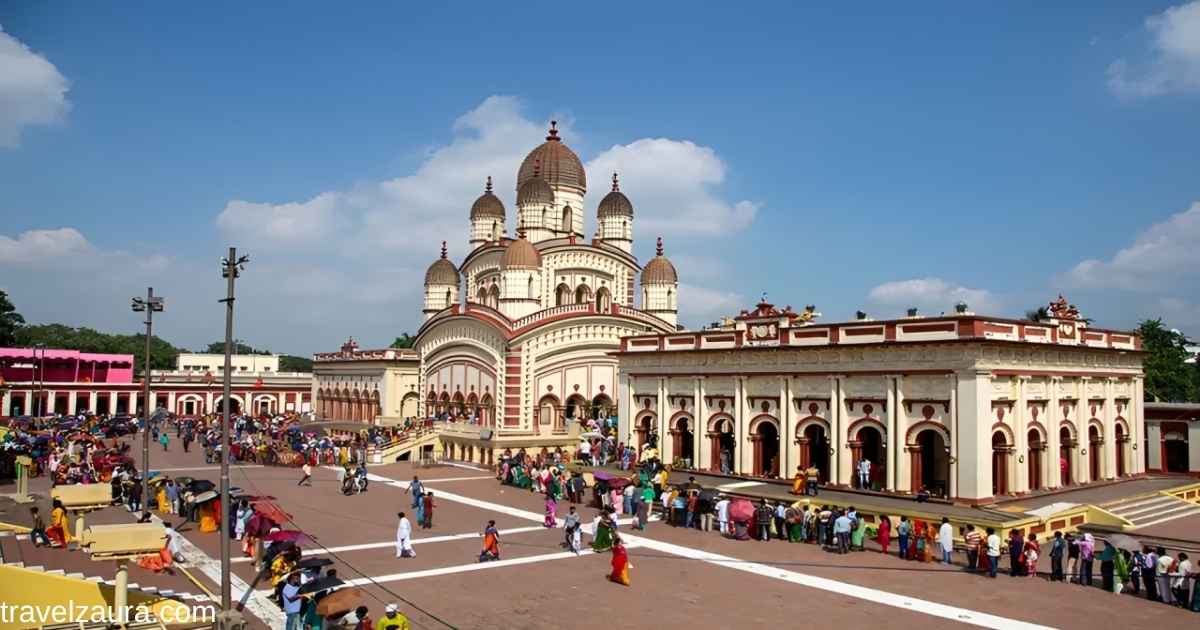
Dakshineswar Kali Temple photos are widely searched by travelers planning their trip, especially images of the nine-spired main shrine and the riverside ghats at sunset. The temple’s white-and-red facade against the Hooghly River makes it a popular subject for photography.
You can generally photograph the outdoor courtyard areas, but the temple restricts photography inside the inner sanctum, so check current signage before taking pictures near the main deity.
Local Food Near Dakshineswar Skywalk
The Dakshineswar Skywalk connecting the metro station to the temple has several small eateries and stalls selling Bengali snacks and sweets. Puchka, kachori, and jalebi are popular quick bites among visitors.
For a sit-down meal, a few local restaurants near the temple entrance serve traditional Bengali thali and vegetarian prasad-style food at affordable prices.
Nearby Places to Visit From Temple
Dakshineswar’s location along the Hooghly makes it easy to combine with other nearby spiritual and heritage sites in a single trip.
Most nearby attractions are within a 20 to 30 minute journey, making a half-day extended itinerary quite feasible.
Belur Math and Vivekananda Setu
Belur Math, headquarters of the Ramakrishna Mission, sits directly across the river and is accessible via Vivekananda Setu bridge or a short ferry ride.
Safety Tips for Temple Visitors
Crowds can build quickly during evening aarti and festival days, so staying alert in dense queue areas is important. Keep valuables secure, as with any high-footfall pilgrimage site.
- Avoid carrying large bags inside the sanctum
- Stay hydrated, especially during summer visits
- Keep children close during peak evening hours
- Use designated footwear counters, not informal vendors
Festival Calendar at Dakshineswar Temple
Kali Puja and Durga Puja bring the largest crowds to Dakshineswar Kali Temple, with elaborate decorations and extended darshan hours. Janmashtami and Ramakrishna’s birth anniversary are also significant dates on the temple calendar.
Visiting during these festivals offers a vibrant experience, but expect long queues and limited parking near the complex.
Guest House and Accommodation Options
The Ramakrishna Mission runs a limited guest house near the temple for pilgrims, though availability is often tight and booking is recommended. Beyond this, hotels near Dakshineswar Kali Temple range from budget lodges to mid-range hotels within a few kilometers.
Most travelers choose to stay in central Kolkata and visit Dakshineswar as a day trip, given the short metro and taxi connectivity.
Frequently Asked Questions
What is special about Dakshineswar Kali Temple?
Dakshineswar Kali Temple is famous for its nine-spired architecture, riverside setting, and deep connection to Sri Ramakrishna, who lived and meditated here for years.
What is the difference between Kalighat and Dakshineswar?
Kalighat stands as an ancient Shakti Peeth in central Kolkata, while builders constructed Dakshineswar Kali Temple was built in 1855, and the temple carries forward Sri Ramakrishna’s spiritual legacy.
How much time is required to visit Dakshineswar Temple?
Most visitors spend 60 to 90 minutes at Dakshineswar Kali Temple, covering the main shrine, Panchavati, and the twelve riverside Shiva temples comfortably.
Is Dakshineswar Kali Temple considered a Shakti Peeth?
No, Dakshineswar Kali Temple is not a traditional Shakti Peeth. Its significance comes from Rani Rashmoni’s founding and Sri Ramakrishna’s worship, not mythological origin.
What is not allowed in Dakshineswar Temple?
Sleeveless clothing, shorts, footwear inside the sanctum, and photography near the main deity are not allowed at Dakshineswar Kali Temple during darshan hours.
Conclusion
Dakshineswar Kali Temple remains one of Kolkata’s most visited pilgrimage sites, drawn to the Dakshineswar Kali Murti and the temple’s deep ties to Sri Ramakrishna. Check Dakshineswar Temple timings before you go, since summer and winter darshan hours differ.
The Dakshineswar Kali Temple nearest metro station and nearest railway station make the journey easy from anywhere in the city. Note that Dakshineswar Kali Temple is not located in Jaipur or Haridwar, and it is not a Shakti Peeth, unlike Kalighat. Carry a camera for the riverside Dakshineswar Kali Temple photos, dress modestly, and visit early in the morning for the calmest darshan experience along the Hooghly.