
Arunachaleswarar Temple stands in Tiruvannamalai, Tamil Nadu, at the base of Arunachala Hill. The sacred place is also called Annamalaiyar Temple, and its tradition is closely tied to Agni, the element of fire.
Giri Pradakshina is the devotional circumambulation of Arunachala Hill, commonly called Girivalam. Devotees may come for temple darshan, the hill walk, or both. Schedules and crowd levels can change on full-moon days and festivals, so the day you choose can shape the entire visit.
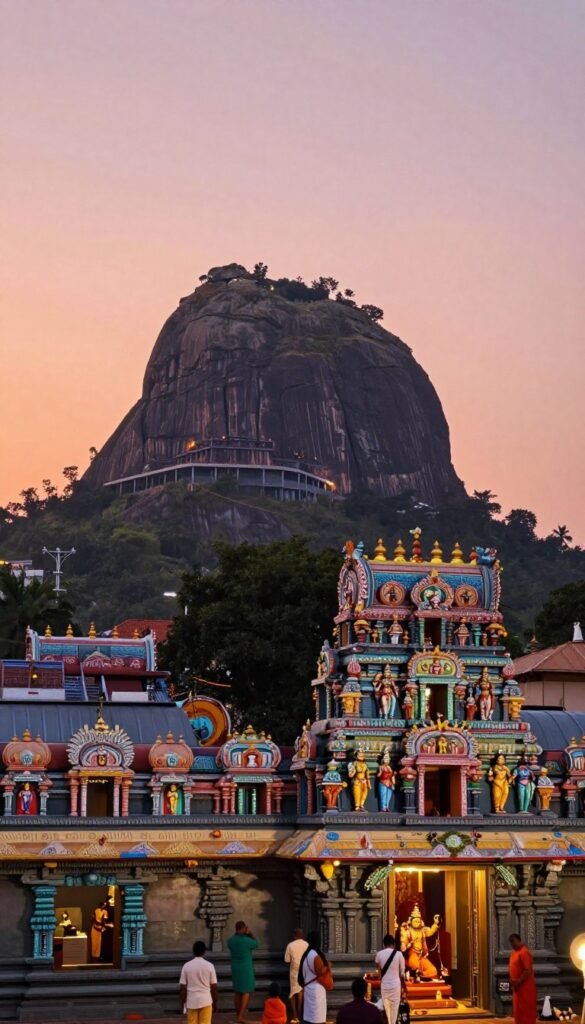
For a smooth visit, first decide how much time you can set aside and whether you want to walk. Then check the day’s temple timings before traveling.
Arunachalam Temple Timings Today
Commonly listed temple timings are 5:30 AM-12:30 PM and 3:30 PM-8:30 PM, though other schedules differ. Check the date before traveling because the morning opening and evening closing can change.
Use the hours as a planning guide, not a guarantee for every day. Official temple notices or local confirmation can help you avoid arriving during a closure or a changed ritual schedule.
Temple hours vary by schedule and date, so confirm the current opening and closing times before you travel.

Opening and closing timings
Two commonly listed schedules show different opening and closing times. The morning session is listed as either 5:00 AM-12:30 PM or 5:30 AM-12:30 PM. Evening hours are listed as either 3:30 PM-8:30 PM or 3:30 PM-9:30 PM.
| Session | Commonly listed hours | Schedule variation |
|---|---|---|
| Morning | 5:00 or 5:30 AM-12:30 PM | Opening time differs |
| Evening | 3:30-8:30 PM or 3:30-9:30 PM | Closing time differs |
Darshan windows and interruptions
Darshan generally follows the open morning and evening sessions. A shrine may pause for a ritual, though the wider temple remains open, so a brief wait can be part of the visit. Keep some flexibility in your plans if you are arriving close to a session change.
Morning darshan may suit visitors who want to begin early, while an evening visit can fit a later arrival. The temple’s ritual schedule, not just the outer gates, affects when worshippers can approach a shrine.
Pooja and Pournami schedule changes
Listed aarti times vary: one schedule gives morning aarti at 6:00 AM and evening aarti at 9:00 PM, while another lists evening Deepa Aradhana at 6:00 PM. Treat those times as schedule-specific rather than daily promises.
On Pournami, the full-moon day, and during festivals, hours can extend to 10:00 PM. Larger crowds can also lengthen queues and slow movement through the temple. Check the day’s current notice, then compare entry and ticket options before deciding how to visit.
Darshan Tickets, Fees, and Online Booking
General darshan at Arunachaleswarar Temple is free, while special darshan may require a separate ticket. Ask what applies that day, since counter availability and fees can change with the temple’s arrangements.
Do not assume that a special ticket or online booking will be available for your visit date. The Arunachalam Temple darshan tickets price depends on current arrangements, so confirm the fee through official temple channels or at the temple counter.
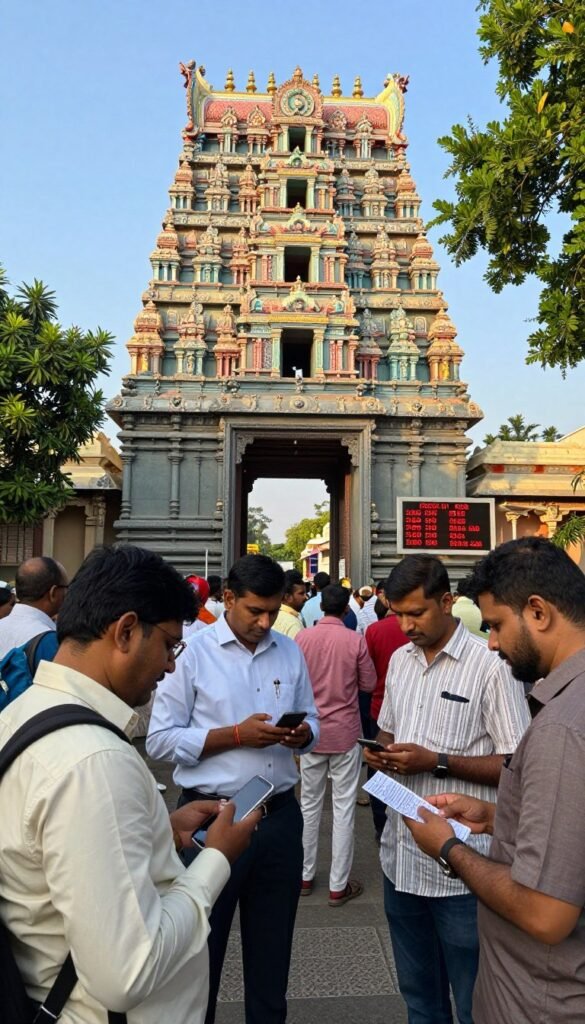
Free darshan and special darshan tickets
Visitors can join the general darshan queue without buying a ticket. Special-darshan tickets are described as available at temple counters, but the option may not be offered at every time or on every day. Queues and access arrangements can also differ during busy periods.
If you are comparing Arunachalam Temple darshan tickets, check both availability and the current fee before setting a budget. A ticket should not be treated as a promise of a particular wait time or direct access to a shrine.
Official ticket information and online booking
Arunachalam Temple online booking should be confirmed through official temple channels. Online reservations may not be available for every service or date, so do not rely on a booking page unless it clearly lists the option you need.
For current entry arrangements, use the temple’s official information or ask at the counter. This is especially useful when you are planning a specific ritual, since services and booking rules can differ from general darshan.
For a closer look at possible ticket types and booking arrangements, see this Arunachalam Temple darshan tickets guide. Treat any listed fee as date-sensitive and confirm it before you pay.
Entry rules for visitors
Remove your footwear before entering and use the designated storage area. Modest clothing is a respectful choice. Photography rules can differ by area, and cameras or phones are restricted near the sanctum. Do not assume that every outer area has the same photography rules.
- Confirm ticket availability and the current fee.
- Check the entry rules for the areas you plan to visit.
- Use designated footwear storage before entering.
These small checks make the entrance easier to manage, especially if you are arriving with a group. Once the practical details are clear, the temple’s history and spiritual identity add meaning to the darshan.
History and Spiritual Significance of Arunachaleswarar
In a Shaivite legend, Shiva appeared as an immeasurable pillar of fire, and Brahma and Vishnu could not find its limits. The story is a religious tradition, not a verified historical event, and it explains the temple’s link with Agni.
Arunachaleswarar represents the fire element among the Pancha Bhoota Sthalams, five sacred Shiva temples linked with the elements. The temple and Arunachala Hill are central to the significance of sacred Arunachala in Shaivite worship.

The fire-pillar legend and the Agni Lingam
The legend tells how Brahma and Vishnu searched in opposite directions for the top and bottom of Shiva’s fiery form. Neither found an end. Worshippers understand the Agni Lingam as a form connected to that fire tradition and to Shiva’s immeasurable presence.
This belief gives the hill a sacred role, not merely a scenic one. The temple’s identity as an Agni shrine is part of a wider tradition that associates specific Shiva temples with earth, water, fire, air, and space.
Arunachaleswarar and Unnamulai Amman
Arunachaleswarar is the presiding Shiva deity, and Unnamulai Amman is the Goddess Parvati deity. Visitors can take darshan of both deities, observe worship, and notice how the temple’s spaces support daily religious practice.
What happens if you visit? You can take darshan, see the architecture, and choose to undertake Girivalam. The visit may include prayer or quiet reflection, but no particular spiritual outcome can be promised.
The hill’s place in Shaivite tradition
Religious tradition connects Shiva with fire at Arunachala, while inscriptions and devotional texts offer a different kind of historical record. Chola inscriptions and construction activity are associated with the 9th century onward. The temple history spans many periods of patronage and building.
The temple is also praised in the Tamil devotional works Thevaram and Thiruvasagam. These writings reflect its place in Shaivite devotion, while inscriptions document parts of its past. That blend of sacred tradition and recorded history leads naturally to the built form visitors see today.
Temple Architecture at Tiruvannamalai
The temple complex covers about 25 acres and contains nine gopurams, or entrance towers. Its scale is easiest to grasp from the eastern approach, where the main tower rises above the surrounding streets.
The eastern Rajagopuram is 217 feet (66 meters) tall and was completed in 1572 CE during Krishnadevaraya’s reign. Dravidian-style towers, courtyards, and carved pillars give the complex its distinct shape.
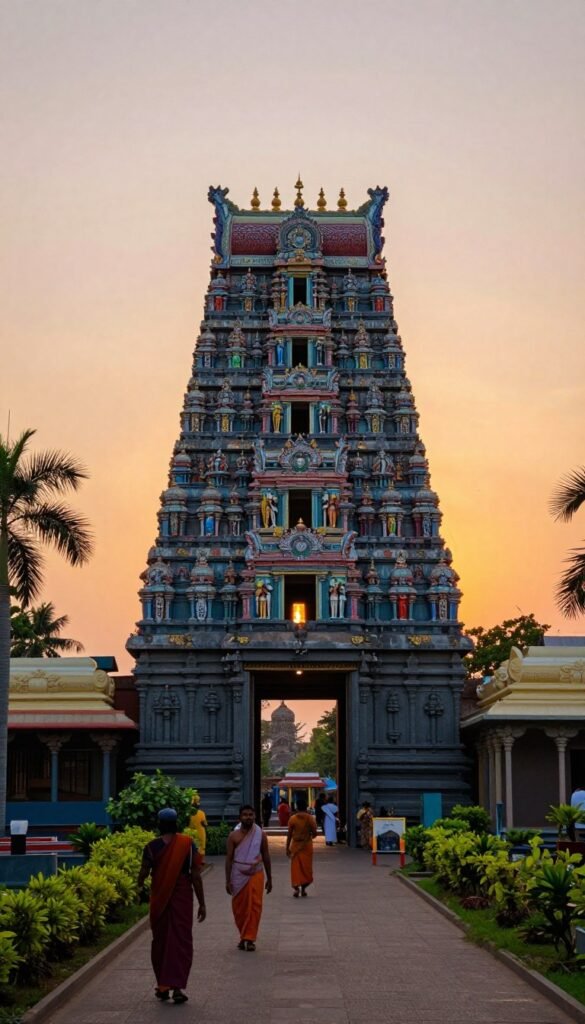
Gopurams, courtyards, and the thousand-pillared hall
The temple’s multiple courtyards separate parts of a large working place of worship. The thousand-pillared hall dates to around 1509 CE and is known for its carved stone pillars. Take time to look upward and across the hall, rather than trying to take in every detail while moving with the crowd.
| Feature | Measurement or date | Visitor detail |
|---|---|---|
| Temple complex | About 25 acres | Large multi-courtyard complex |
| Eastern Rajagopuram | 217 feet (66 meters); completed in 1572 CE | Principal eastern tower |
| Thousand-pillared hall | Around 1509 CE | Carved stone hall |
Where visitors can take photos
Rules for Arunachalam temple photos depend on the area. Follow posted signs and staff directions, and avoid photography near the sanctum. Do not assume that a camera is permitted during worship or inside every part of the complex.
When photography is allowed, exterior views can capture the towers, stonework, and courtyards without interrupting worship. The architecture is especially striking when you pause to notice how the carved pillars frame each space. The temple’s great festival brings the hill and its fire symbolism into view on a much larger scale.
Karthigai Deepam and Other Festival Days
Karthigai Deepam is the signature festival at Tiruvannamalai and attracts large crowds. The hilltop lamp is the defining sight: it connects the celebration to the temple’s fire tradition.
The ten-day festival, held in the Tamil month of Karthigai, roughly November-December, culminates with a large lamp lit on Arunachala Hill at sunset. The event happens every year, though specific arrangements and dates should be checked for the year you plan to visit.
The sight draws worshippers and visitors toward the hill and temple. If you want a quieter visit, avoid assuming the festival will feel like an ordinary day. Full moon days and Mahashivaratri also bring heavy crowds, especially around the temple and the hill circuit.
Before setting out during a busy period, build extra time into every part of the day. A crowded approach can affect your entry, walking pace, and plans to leave town.
- Expect heavy crowds at the temple and around the hill.
- Confirm current arrangements locally before traveling.
- Allow extra time for entry and movement through busy areas.
Those crowd patterns matter if you are considering the hill circuit. The practical next question is how far the walk goes and how long you may want to reserve for it.
How Far Is the Girivalam Walk?
The full Girivalam circuit is about 14 kilometers around Arunachala Hill and usually takes roughly 3.5-5 hours on foot. Allow extra time if you plan to stop, walk slowly, or travel on a crowded day.
The Arunachalam Temple Giri Pradakshina distance is approximately 14 kilometers, but the time depends on pace, crowds, and stops. The walk is especially busy on Pournami, so expect more people along the path.
What Girivalam means
Girivalam is the customary circuit around the hill. Its formal name is Giri Pradakshina, the devotional circumambulation of Arunachala Hill. You can undertake the walk independently of temple darshan, so completing one does not require completing the other.
Some pilgrims walk steadily from start to finish. Others pause for prayer, rest, or to manage crowds at points along the route. Those stops make a meaningful difference to the total time, especially when many people are walking together.
Distance and walking time
A continuous walk commonly takes about 3.5-5 hours, though an individual’s pace changes the estimate. Crowds can slow movement, and prayer or rest breaks add time. The full circuit is a substantial walk, so consider your comfort and mobility before committing to it.
You do not have to walk the entire route. A partial walk is a practical choice if heat, energy, or time makes the full circuit unsuitable. You can turn back when needed rather than treating completion as a requirement.
If you are planning the full route, leave space for breaks rather than scheduling another fixed activity immediately afterward. The next decision is where to start and which landmarks to use as you move around the hill.
Girivalam Route, Eight Lingams, and Pilgrim Tips
The Girivalam route forms a loop around the hill and commonly begins near the temple’s eastern entrance. Start by orienting yourself in the eastern temple area, then follow the circuit back toward the same starting area.
The path is open around the clock, but surface and lighting conditions vary along the way. The eight Ashta Lingams give pilgrims a set of landmarks, though they do not make every stretch equally smooth or easy to walk.
Starting point and route direction
Many people begin near the eastern temple entrance and continue around Arunachala Hill. Check local crowd and traffic arrangements before setting off, since conditions can change the easiest way to move through the area.
Some devotees walk barefoot as part of their observance. Comfortable footwear is a useful choice if you prefer shoes, and water can help you manage a long walk. Surface quality and lighting vary, so be prepared for stretches that feel different from the main approach.
Eight directional lingams
The eight lingams mark directions and have traditional associations. Their approximate distances below are measured from the common starting area, so treat them as route guides rather than precise step-by-step measurements.
| Lingam | Direction | Approximate distance from start | Association |
|---|---|---|---|
| Indra | East | 0 km | Rain and prosperity |
| Agni | Southeast | 1.8 km | Fire |
| Yama | South | 3.5 km | Impermanence |
| Varuna | West | 7 km | Water and purification |
| Kubera | North | 10.5 km | Wealth |
The other three are Niruthi in the southwest, about 5.3 kilometers from the start; Vayu in the northwest, about 8.8 kilometers away; and Isanya in the northeast, about 12.2 kilometers away.
Choosing a time and preparing for the walk
The best time visit depends on heat, crowd tolerance, and how long you want to walk. Carry water, use comfortable footwear if you are not walking barefoot, and check traffic arrangements before leaving the temple area.
There is no single ideal hour for every pilgrim. Choose a time that fits your mobility and comfort, then plan transport with enough flexibility for the route and crowd conditions.
Distance to Tiruvannamalai From Major Cities
The distance depends on your starting city and whether you measure by road or rail. Road figures are approximate and vary with the route, traffic, and chosen starting point.
Chennai is about 180-185 kilometers from Tiruvannamalai by road, while the town’s railway station is about 2 kilometers from the temple. The Arunachalam Temple distance is easiest to estimate once you choose your transport mode.
How far is Tiruvannamalai from major cities?
These approximate road distances help you compare journeys, but they are route-dependent rather than fixed measurements. Check your preferred route before setting a departure time, especially if you are connecting with a train or flight.
| Starting city | Approximate road distance | Planning note |
|---|---|---|
| Chennai | About 180-185 kilometers | Direct road journey |
| Bengaluru | About 200 kilometers | Route-dependent road journey |
| Hyderabad | About 600 kilometers | Longer intercity journey |
| Tirupati | About 200 kilometers | Route-dependent road journey |
Reaching the town by road, train, or air
Tiruvannamalai is a town in the state Tamil Nadu, served by rail and road connections. Trains serve Tiruvannamalai, and the station is about 2 kilometers from the temple. From there, local transport can cover the short onward trip.
Chennai International Airport is about 180 kilometers away. Buses and taxis can connect travelers with the town, while local auto-rickshaws are useful for shorter journeys. Services do not follow one fixed timetable across all operators, so allow time for connections.
The temple located in Tiruvannamalai is the main landmark for planning the final leg. Once you have chosen a route, consider how much time and energy you want to reserve for the visit itself.
When to Visit and How to Plan Your Stay
Arunachalam Temple is in Tiruvannamalai, Tamil Nadu, at the base of Arunachala Hill. Choose your dates with heat and crowd levels in mind, since both affect the comfort of a temple visit and a long walk.
November-February is generally cooler for walking, with temperatures commonly reported around 18-28°C. April-June can reach about 35-42°C, so plan carefully if you are visiting during the hotter months.
Pick a visit plan that matches your walking ability, and leave room for rest if heat or crowds slow you down.
Where is Arunachalam Temple located?
The Arunachalam Temple location is Tiruvannamalai, in the state of Tamil Nadu. The temple sits at the base of Arunachala Hill, making it possible to combine darshan with a walk around the hill if your schedule and mobility allow.
The cooler months can be more comfortable for walking, but no date guarantees a quiet visit. Full-moon days and festivals are busier, and heat can make the route more demanding. Choose a day based on your priorities, not only on the calendar.
How many days should you plan?
One day can cover temple darshan and a partial Girivalam. Two days allow a more relaxed visit, with time for the full circuit or nearby ashrams. The best time visit also depends on whether you want to walk, rest, or explore at a slower pace.
- One-day temple visit: focus on darshan and a partial walk.
- Two-day temple-and-Girivalam visit: leave room for the full circuit.
- Slower visit: plan rest breaks or a partial circuit around the hill.
These options give you room to fit the visit to your own pace. Choose the plan that suits your walking ability, then confirm current temple arrangements before setting out.
Conclusion
A successful visit depends on allowing time for both the temple and the hill experience you choose. Darshan alone can make a focused visit, while Girivalam adds a longer walk around Arunachala Hill.
Check current temple timings before you travel, and choose a walking plan that matches your pace and comfort. You can complete the full circuit, take a partial walk, or keep your visit to the temple.
Before leaving, confirm the day’s temple notices and transport arrangements. Set your departure time with enough flexibility for the journey and the visit you have planned.