
Twice a day, the sea swallows a temple whole. You won’t find this anywhere else in India. Picture stepping onto a sacred hillock, waves creeping toward your feet. That’s the Bhadkeshwar Mahadev Temple experience, and it’s unlike any other pilgrimage stop in Gujarat.
Tucked along the western edge of Dwarka, the Bhadkeshwar Mahadev Temple location sits on a rocky perch where the Arabian Sea meets ancient devotion. Locals simply call it Bhadkeshwar Mahadev Temple Dwarka, and once you see the tide rise around its base, you’ll understand why. The scenery hides a rich Bhadkeshwar Mahadev Temple history, tied to a self-manifested Shivalinga that people believe is over 5,000 years old a story so revered that local pilgrims and priests often share it as Bhadkeshwar Mahadev Temple history in Hindi.
Before you go, it helps to check the Bhadkeshwar Mahadev Temple timings and plan around low tide, since the walkway to the shrine floods completely at high tide. The Bhadkeshwar Mahadev Temple to Dwarkadhish Temple distance is barely 2 km, so most travelers pair their visit with the iconic Dwarkadhish Temple on the same trip. If you have more time, extend the journey to Nageshwar Jyotirling, Rukmini Devi Temple, and the peaceful Gomti Ghat, all just a short Bhadkeshwar Mahadev Temple distance away. And if you’re already scrolling through Bhadkeshwar Mahadev Temple photos online, nothing compares to standing there yourself as the sea rises to meet Mahadev.
Bhadkeshwar Mahadev Temple Location
The temple sits on a small hillock jutting into the Arabian Sea, on the western edge of Dwarka town in Gujarat. Its coastal, semi-island setting is what makes the Bhadkeshwar Mahadev Temple location so distinctive among Gujarat’s pilgrimage spots.
Unlike temples built on flat ground, this one rises above the tide line, so a short walkway connects it to the mainland. That walkway floods at high tide, which shapes almost every part of planning your visit.
History Of Bhadkeshwar Mahadev Temple
People believe this ancient temple, home to the self-manifested Swayambhu Shivalinga, dates back roughly 5,000 years. Tradition holds that the revered Jagadguru Adi Shankaracharya established the temple at the confluence of the Gomti River, the Ganga, and the Arabian Sea.
The Bhadkeshwar Mahadev Temple history also includes a striking detail: the site holds around 1,300 Shiva lingams, 75 metal relics linked to Shankaracharya, and 1,200 Salgramsheelas. The presiding deity is worshipped here as Chandra-Mouliswar Shiva.
Bhadkeshwar Mahadev Temple History In Hindi
भाडकेश्वर महादेव मंदिर लगभग 5000 वर्ष पुराना माना जाता है। मान्यता है कि यहां स्वयंभू शिवलिंग समुद्र में स्वयं प्रकट हुआ था और इस मंदिर की स्थापना गोमती, गंगा और अरब सागर के संगम पर जगद्गुरु आदि शंकराचार्य द्वारा की गई थी। यह मंदिर भगवान शिव को चंद्र-मौलीश्वर रूप में समर्पित है।
Legend Of The Self-Manifested Shivalinga
Local belief describes the Shivalinga as swayambhu, meaning it manifested on its own rather than being installed by human hands. Folklore places its discovery near Chakratirth Beach, found by a sage engaged in meditation.
Some regional oral traditions also connect the site to Krishna’s era, suggesting the shrine existed even during the Dwarka kingdom period and survived repeated sea erosion over centuries. This layered legend is a big part of why devotees consider a Bhadkeshwar darshan spiritually significant, beyond its scenic appeal.
Bhadkeshwar Mahadev Temple Timings
The temple is generally open daily from around 6:00 AM to 7:00 PM. Since access depends on the tide, it’s worth confirming timings locally, especially if you’re visiting during monsoon season.
Entry itself is free, though a special darshan option is sometimes available for a small optional fee. Early morning or late evening slots tend to be quieter and cooler for most visitors.
You May Also Visit: Sree Padmanabhaswamy Temple: Everything You Need to Know Before You Visit
Best Time To Visit The Temple
Winter, from November to February, is widely considered the best time to visit, thanks to cooler and more comfortable weather. Low tide hours are equally important since the temple is only walkable when the sea has receded.
If you want to witness the famous sea-submergence phenomenon, plan your trip around June or July instead, keeping in mind the weather will be far more humid.
Season-Wise Weather Table
| Season | Months | Temperature | Notes |
| Winter | Nov to Feb | 15°C to 28°C | Best for comfortable darshan and photography |
| Summer | Mar to Jun | 24°C to 40°C | Hot and dry, carry sun protection |
| Monsoon | Jul to Sep | 25°C to 35°C | Heavy rain, sea submergence ritual occurs |
Sea Submergence Ritual Explained
Each year, typically in June or July, the ocean itself performs an abhishek of the Shivling as the sea rises and briefly engulfs the temple. Devotees interpret this natural event as the sea’s own act of devotion rather than a man-made ceremony.
During this window, water can surround the entire structure for a short period until the ritual completes, after which the tide recedes to normal levels. This rare natural phenomenon draws photographers and pilgrims alike.
Entry Fee And Ideal Visit Duration
There is no entry fee to visit the temple, and the ideal visit duration is around two to four hours. That window comfortably covers darshan, photos, and time to enjoy the coastal views.
Optional donations for temple upkeep are welcome but not compulsory, and small vendor charges for parking or puja items may apply separately.
Festivals Celebrated At The Temple
Maha Shivratri is the temple’s biggest festival, when a large fair is organized on the grounds and thousands of devotees gather. The celebration usually falls in February or March and includes special night-long prayers.
Outside of Shivratri, the temple sees a steady flow of pilgrims, but festival days bring a noticeably livelier, community-driven atmosphere.
Dress Code And Temple Etiquette
Visitors must dress modestly and remove their footwear before entering the sanctum. Some areas may restrict photography, so check the on-site signage before taking pictures.
- Wear modest, comfortable clothing suited to walking on rocky terrain
- Remove shoes before the sanctum
- Avoid loud behavior near the shrine
- Follow posted photography rules
How To Reach Bhadkeshwar Mahadev Temple
Most visitors combine this temple with a Dwarkadhish darshan since both sites sit close together. Getting here is straightforward whether you’re arriving by air, rail, or road.
Nearest Airport And Railway Station
Jamnagar Airport is the nearest airport, roughly 130 to 140 km from Dwarka, connected to cities like Mumbai and Ahmedabad. The nearest railway station is Dwarka Railway Station, about 4 km from the temple.
By Road From Dwarkadhish Temple
A shared auto from Dwarkadhish Temple takes around five minutes, or you can walk along the beach route past Gita Mandir for a more scenic approach. Always check the tide schedule first, since the temple isn’t reachable on foot during high tide.
Bhadkeshwar Mahadev Temple To Dwarkadhish Temple Distance
The Bhadkeshwar Mahadev Temple to Dwarkadhish Temple distance is approximately 2 km. This short Bhadkeshwar Mahadev Temple distance makes it easy to cover both temples in a single half-day pilgrimage circuit.
Nearby Places: Nageshwar Jyotirlinga, Rukmini Devi Temple
Nageshwar Jyotirlinga, one of the 12 revered Jyotirlingas, is located about 17 to 18 km from Dwarka city. It’s easily combined with your Bhadkeshwar visit if you have a full day to explore.
Rukmini Devi Temple, dedicated to Lord Krishna’s queen, is about 2 km from Dwarkadhish Temple. Both sites are commonly included in the same pilgrimage loop as Bhadkeshwar.
Gomti Ghat Near Bhadkeshwar Mahadev
Gomti Ghat sits close to Dwarka Railway Station and is considered an important spot where devotees take a holy dip before temple visits. Many pilgrims stop here on the way to or from Bhadkeshwar for riverside prayers.
The ghat’s calm waters and temple-lined banks make it a peaceful stop, especially around sunrise or sunset.
Bhadkeshwar Mahadev Temple Photos
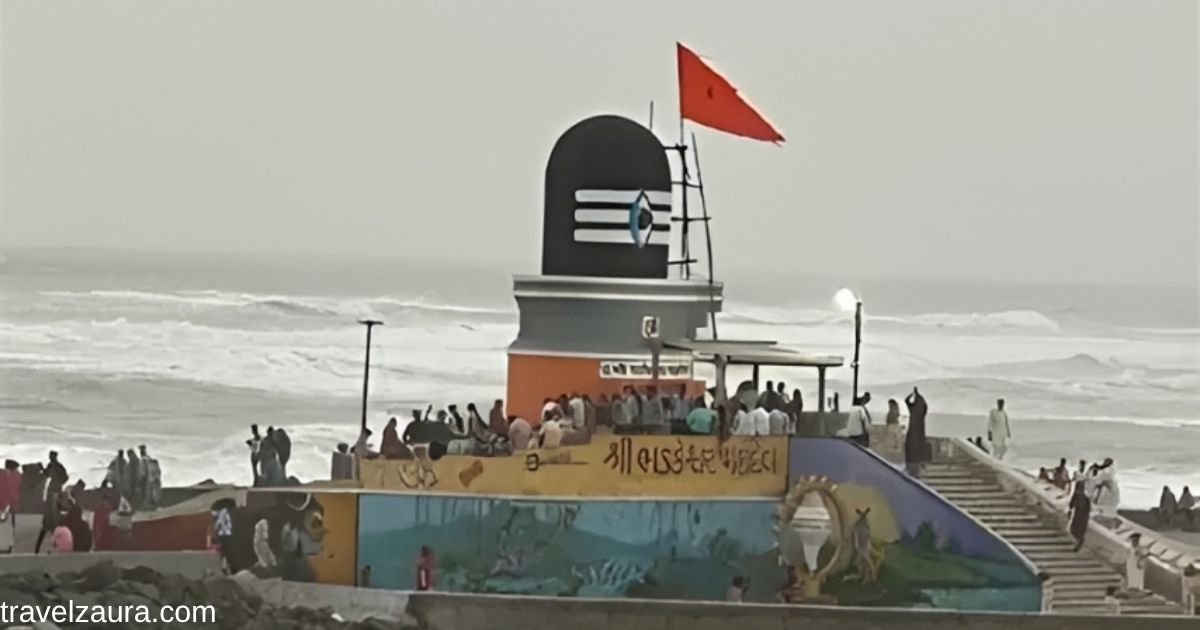
The temple’s cliffside setting, framed by the Arabian Sea, makes it one of the most photogenic spots in Dwarka, particularly at sunset. Low tide is the best time to capture the full structure along with the surrounding rocky terrain.
If you’re searching for Bhadkeshwar Mahadev Temple photos online before your trip, look for images taken during both low and high tide to understand how dramatically the setting changes.
Safety Tips Before You Visit
Tide timing is the single biggest safety factor here, so always confirm the schedule locally before walking out to the shrine. Wet rocks can be slippery, so sturdy, non-slip footwear is strongly recommended.
- Check tide timings before heading to the temple
- Avoid the walkway during high tide or heavy monsoon swells
- Carry water, as shade is limited on the hillock
- Keep children close on the rocky sections
Budget Breakdown For Dwarka Trip
A simple day trip covering Bhadkeshwar, Dwarkadhish, and nearby sites can be managed affordably. Costs vary by travel style, but here’s a rough daily estimate for planning purposes.
| Expense | Budget Traveler | Mid-Range Traveler |
| Local transport | ₹200 to ₹400 | ₹800 to ₹1,200 |
| Food | ₹300 to ₹500 | ₹700 to ₹1,000 |
| Accommodation | ₹800 to ₹1,500 | ₹2,500 to ₹4,000 |
Packing Guide For Dwarka Visit
Light, breathable cotton clothing works best given the coastal heat, along with sunglasses and sunscreen. Pack a pair of easy-to-remove sandals since footwear comes off at multiple temple entrances.
- Modest cotton clothing
- Sun protection: hat, sunglasses, sunscreen
- Comfortable, slip-resistant sandals
- A light waterproof layer if visiting during monsoon
Local Food Near Dwarka Beach
Dwarka’s beachside stalls serve simple, satisfying Gujarati snacks like khaman, fafda, and fresh coconut water, perfect after a temple walk. Several small eateries near the beach also offer thali meals with a coastal touch, such as fresh seafood-inspired sides in nearby fishing areas.
For a relaxed evening, many travelers wind down with tea and snacks along the beach promenade while watching the sunset over the Arabian Sea.
Frequently Asked Questions
What is the history of the Bhadkeshwar Mahadev Temple?
The Bhadkeshwar Mahadev Temple is an ancient shrine dating back roughly 5,000 years, built around a self-manifested Shivalinga discovered at the Gomti-Arabian Sea confluence.
Where is the Bhadkeshwar Mahadev Temple located?
The Bhadkeshwar Mahadev Temple is on a hillock jutting into the Arabian Sea, on Dwarka’s western coastline in Gujarat, India.
Which temple disappears twice a day?
Bhadkeshwar Mahadev Temple partially submerges during high tide and reappears at low tide, making it one of the few temples with daily sea-timed visibility.
What is the best time to visit Bhadkeshwar Mahadev Temple?
The best time to visit Bhadkeshwar Mahadev Temple is between November and February, during low tide hours, for cooler weather and easy temple access.
How far is Bhadkeshwar Mahadev Temple from Dwarkadhish Temple?
Bhadkeshwar Mahadev Temple is about 2 km from Dwarkadhish Temple, making it easy to visit both shrines in a single half-day pilgrimage circuit.
Conclusion
Bhadkeshwar Mahadev Temple rewards travelers who plan around the tide. Confirm the temple’s timings (6 AM to 7 PM) and check low tide before heading out, since the walkway floods otherwise. Its location, a sea-facing hillock in Dwarka, pairs perfectly with a same-day visit to Dwarkadhish Temple, just a short distance away. Extend your trip to Nageshwar Jyotirlinga, Rukmini Devi Temple, and Gomti Ghat for a complete Dwarka pilgrimage circuit.
Carry sturdy footwear, arrive for sunset, and capture the coastline for stunning photos. Understanding the history of this ancient shrine and how it compares to Bhadkeshwar Mahadev Temple Dwarka gujarat listings online adds real depth to what is otherwise just a scenic stop.